When It’s Not an Accident: Recognizing and Responding to Deliberate Interference in Elder Care
When family interference in elder care is deliberate, communication alone won’t fix it. Learn to recognize the signs, understand the motives, and take action to protect your parent.
Rondalynn Chapman
4/18/20265 min read
When It’s Not an Accident: Recognizing and Responding to Deliberate Interference in Elder Care
In our last post, we talked about family members who insert themselves into an aging parent’s care with good intentions but harmful results. Today we are addressing something harder to name — and harder to live with.
Some interference is not accidental. Some family members deliberately work to undermine the primary caregiver, manipulate the aging parent, or position themselves to gain control — whether that’s financial control, decision-making authority, or simply the upper hand in a family dynamic that has been complicated for decades.
If you have felt like something more calculated is going on, you are probably right. And you deserve more than a suggestion to “communicate better.”
What Deliberate Interference Looks Like
Intentional interference can be subtle enough that caregivers spend months second-guessing themselves before they trust what they are seeing. Some of the most common patterns include:
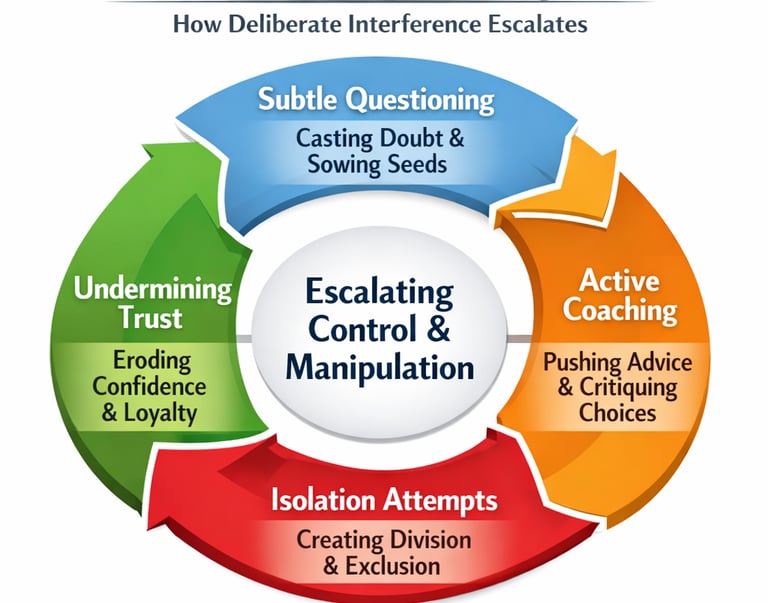
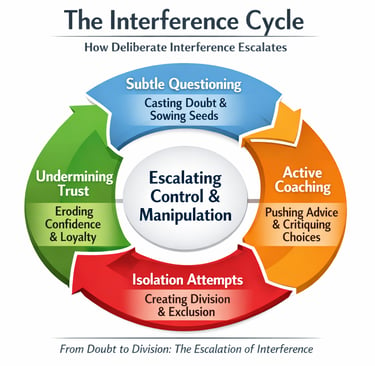
Systematic coaching. A family member regularly feeds your aging parent false or distorted information about your competence, your motives, or the care you are providing. This is not a one-time misunderstanding — it is a pattern, and its effect is to erode your parent’s trust in you over time.
Manufacturing dependency. Some family members position themselves as the only trustworthy person in the parent’s life — encouraging the parent to call them with every concern, discouraging outside relationships, and subtly isolating the parent from the primary caregiver and others in their support network.
Weaponizing the parent. In more aggressive cases, the family member uses the aging parent as a messenger or instrument — prompting them to make demands, repeat accusations, or refuse care based on things they have been told. The parent may not realize they are being used this way.
Interference with providers. Contacting doctors, home health agencies, or care facilities directly to contradict your instructions, raise unfounded concerns about your caregiving, or attempt to redirect the parent’s care without your knowledge.
Why Does This Happen?
Understanding the motivation will not make the behavior acceptable, but it can help you respond strategically rather than just reactively.
Financial interest is one of the most common drivers. An inheritance, a family home, or access to a parent’s accounts can bring out behavior in family members that nothing else would. If the person interfering stands to gain financially from weakening your role — or from gaining the parent’s favor — that context matters.
Old family wounds run deep. Sometimes deliberate interference is rooted in long-standing resentment — of you, of your relationship with the parent, or of the circumstances that led to you becoming the primary caregiver. The caregiving situation becomes the arena for a conflict that started long before your parent needed help.
Control and identity can also be powerful motivators. For some people, being seen as the most important or most loved child is deeply tied to their sense of self. Watching someone else hold the primary caregiving role — and the closeness that comes with it — can provoke behavior that is more about their own pain than any genuine concern for the parent.
None of these motivations excuse the harm being caused. But knowing what you are dealing with helps you stop trying to solve the wrong problem.
If this is already feeling familiar, you’re not alone.
I created a simple Morning Reset to help you feel a little more grounded before the day even begins—especially on days
when emotions are already running high.
Get your free copy of the Morning Reset
What You Can Do
Document everything, starting now. Keep a dated log of incidents — what was said, what was changed, what your parent reported being told, and any impact on their care or wellbeing. Write it down the same day it happens. This record matters if you ever need to involve professionals, legal authorities, or a care facility’s administration.
Protect the lines of communication with your parent’s care team. Make sure your parent’s doctors, specialists, and home care providers know who the designated caregiver is and who has authority to make decisions. If you hold healthcare power of attorney, ensure that document is on file everywhere it needs to be. Ask providers to flag it if someone attempts to countermand your instructions.
Stop trying to resolve this privately. When interference is deliberate, good-faith family conversations rarely work — and they can actually give the interfering party more information to use against you. This does not mean shutting down all communication, but it does mean recognizing the limits of what you can solve on your own.
Bring in a neutral professional. A geriatric care manager, hospital social worker, or elder mediator can assess the situation, facilitate structured family conversations, and advocate for your parent’s best interests in a way that carries weight with everyone involved. Their presence changes the dynamic.
When to Seek Legal and Protective Help
There are situations where deliberate interference rises to the level of elder abuse — particularly when it involves financial exploitation, isolation, or manipulation that puts your parent’s health or safety at risk. If you believe that is happening, please do not wait.
An elder law attorney can help you understand your legal standing, enforce any existing documents like power of attorney or guardianship, and advise you on steps to protect your parent. Many offer initial consultations at low or no cost.
Adult Protective Services (APS) exists in every U.S. state and can investigate reports of elder abuse, including financial exploitation and emotional manipulation. You can contact APS directly — you do not need an attorney to make a report, and reports can often be made anonymously. Find your state’s APS through the Eldercare Locator at eldercare.acl.gov or by calling 1-800-677-1116.
The National Center on Elder Abuse (NCEA) at ncea.acl.gov is another strong starting point for understanding your options and finding local resources.
You Are Not Overreacting
One of the cruelest effects of deliberate interference is that it often makes the primary caregiver doubt their own perception. If you have been told you are being too sensitive, too controlling, or too suspicious — and yet the pattern keeps repeating — trust what you are seeing.
Protecting your aging parent from manipulation is part of caregiving. So is protecting yourself. The fact that you are paying close enough attention to recognize that something is wrong is not a sign of paranoia. It is a sign that you are doing your job.
You do not have to navigate this alone. Reach out to the professionals and resources above — and know that naming what is happening is not an act of aggression toward your family. It is an act of love toward your parent.
A Gentle Place to Start
You don’t have to figure all of this out at once.
Start with something small. Something steady.
The Morning Reset was created to help you begin your day feeling a little more calm and grounded—especially when you’re carrying this much.
Get you free copy of the Morning Reset
You don't have to keep carrying this alone.
You don't need to have all the answers before you begin.
You just need a place to start.
The Caregiver Clarity Guide was created to help you move from second-guessing to steadier decisions—one framework at a time.
© 2026, RjGj Creative Solutions.
I understand that all sales are final due to the digital nature of this product. Full Terms & Conditions.
Contact
Get tips and updates from RjGj Creative Solutions